


Pew Research Center has conducted three major Religious Landscape Studies over the past 17 years, each with a nationally representative sample of more than 35,000 participants. Because the U.S. Census does not collect data on religious identity, these large-scale surveys offer one of the most authoritative measures of the size and makeup of American religious groups. The findings provide a statistical map of religion nationally, as well as in all 50 states and the District of Columbia.
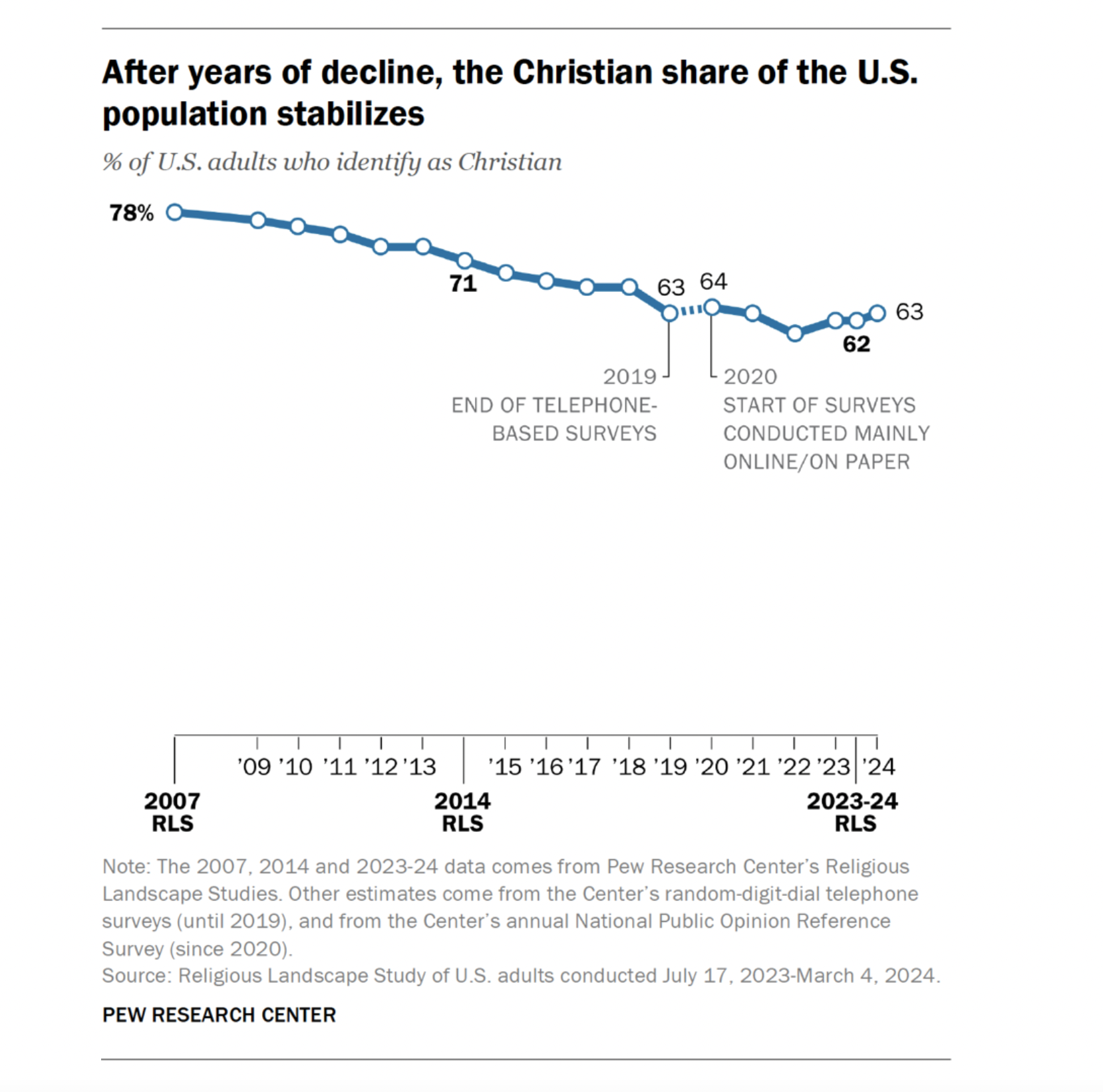
The first study in 2007 found that 78% of U.S. adults identified as Christians. By 2014, that share had dropped to 71%. Protestants remain the largest Christian subgroup at 40%, while Catholics make up 19%. Meanwhile, the number of Americans identifying with non-Christian faiths has continued to grow. Today, 7% of U.S. adults say they belong to a non-Christian religion—including 1.7% who identify as Jewish, 1.2% as Muslim, 1.1% as Buddhist, and 0.9% as Hindu.
The latest Religious Landscape Study, conducted over seven months in 2023–24, finds that 62% of U.S. adults now identify as Christian—a decline of 9 percentage points since 2014.
Prayer and Religious Service Attendance
Pew’s research shows that daily prayer has remained relatively steady in recent years, with 44% to 46% of Americans saying they pray at least once a day. The newest study reports that 44% continue to pray daily.
Church attendance, however, has seen less stability. For several years, the share of adults attending religious services has hovered in the low 30s. According to the 2023–24 study, 33% of Americans now attend services at least once a month.
The latest RLS, fielded over seven months in 2023-24, finds that 62% of U.S. adults identify as Christians. That is a decline of 9 percentage points since 2014 and a 16-point drop since 2007.
Pew Research Center
Spiritual Beliefs Remain Strong
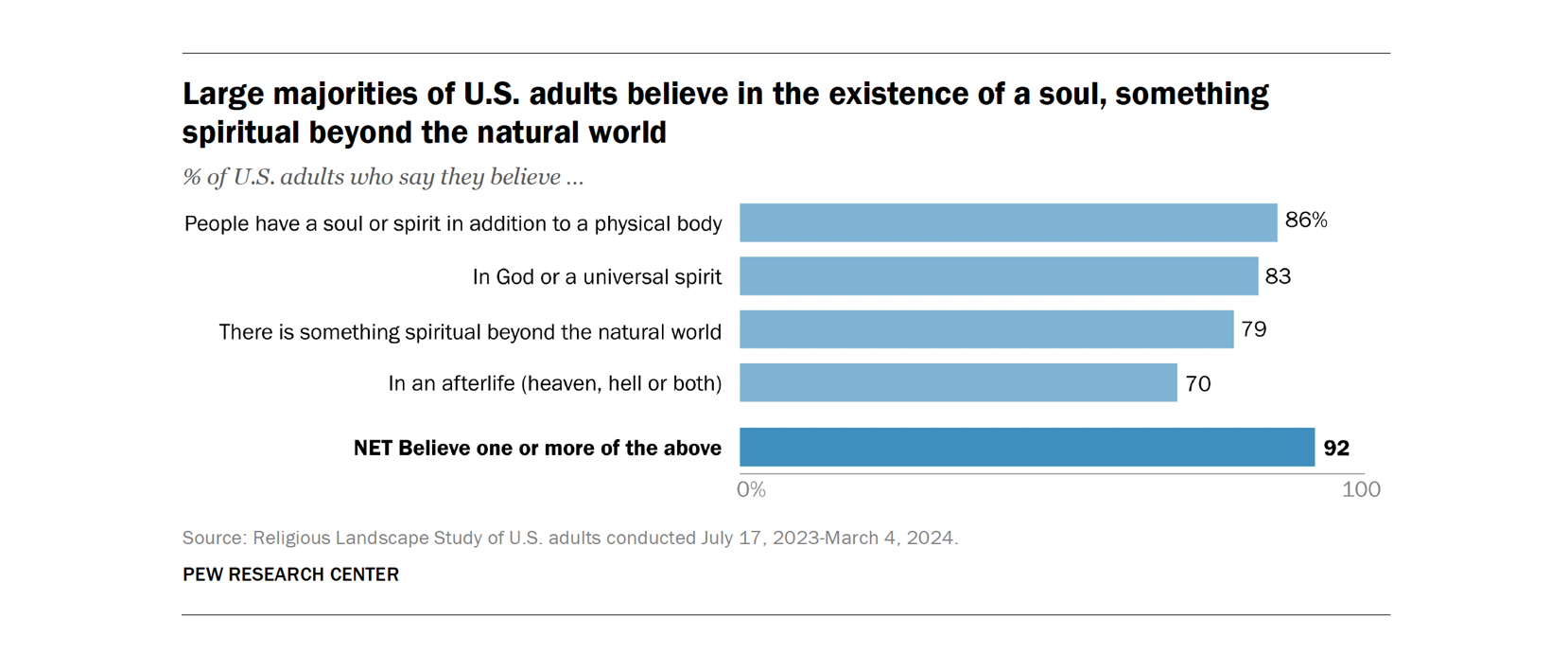
While traditional religious affiliation is declining, a large majority of Americans still hold spiritual or supernatural beliefs. The study shows that many people who do not identify with a particular religion still describe themselves as spiritual or believe in a higher power.
The Future of Christianity in the U.S.
Although Christianity remains the majority faith in America, several indicators point to continued decline in the decades ahead. Younger adults (ages 18 to 24) are significantly less likely to identify as Christian than older adults (75 and up). Forty-three percent of young adults describe themselves as religiously unaffiliated—compared with just 13% of the oldest adults surveyed.
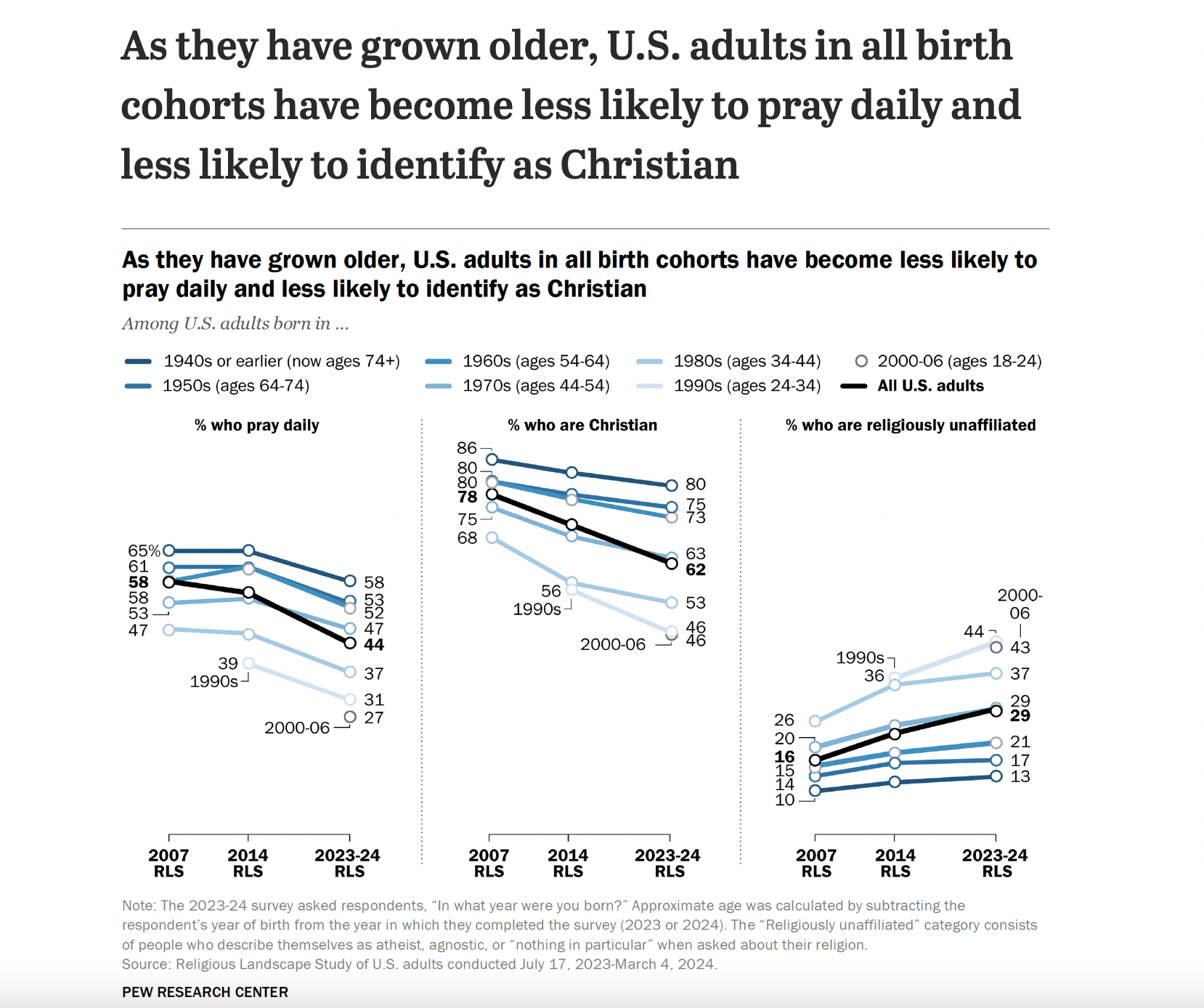
One major driver of these changes is generational replacement. As older, more religious generations pass away, they are succeeded by younger adults who are more likely to be non-religious. For Christianity to stabilize or grow, young adults would need to become more religious as they age, or future generations would need to reverse the trend and embrace religious identity at higher rates.